
Horvat ‘Amuda
As exploration expands to include new areas outside the initial dig area of Beit Lehi, ground surveys and excavations show that the immediate area has a much more extensive archaeological reach than was previously thought. Discoveries in both the south and the north of Beit Lehi shed light on just how much is unknown of ‘The Lost City of Ancient Israel.’ As the reach of the investigation expands, new areas of the Beit Lehi site have been named and are under excavation by archaeologists and the Foundation.
About a half-mile north of base camp at Beit Lehi is one of the new excavation areas identified as Horvat ‘Amuda. The story of its discovery demonstrates the unique process that goes into exploring an archaeological site. Each discovery comes about a little differently, often occurring unintentionally as archaeologists and volunteers scour the area looking for clues of past human settlement.
The story, relayed below by a student volunteer, of the discovery of the Horvat ‘Amuda area reveals the unexpected consequences of exploration and how the story of the area surrounding Beit Lehi continues to unfold year after year. This particular discovery took place during the Beit Lehi Foundation’s May 2016 expedition.
“The day started out as planned. Volunteers, including students and faculty from Utah Valley University and Beit Lehi Foundation president Alan Rudd, loaded up the cars to drive half a mile from the main site of Beit Lehi with lead archaeologist Dr. Oren Gutfeld and other members of his team. The students and faculty from UVU had already planned to map and document a cave (unofficially named the Cave of Pillars) discovered in previous years and set off with the necessary equipment and preparations.
Dr. Gutfeld went ahead in the direction of the entrance to the Cave of Pillars as the rest of the crew unloaded the vehicles. With an excited shout from atop a vista, he began calling back to the volunteers. He was seeing things he never remembered seeing before: remains of another ancient tower as well as clear signs of walls. He and the rest of the team continued to explore and found themselves literally stepping into brand new discoveries.
Over the next few hours students and faculty walked into another vast cave, obviously carved by ancient hands. The remains of the staircase once used to gain access to the room were visible underneath rubble that now buried it. They gained access to an intricate tunnel system and climbed through a few tunnels only to discover more rooms that had quite possibly not been seen since their use after initial construction. What had started out as a day of documentation turned into a day of discovery.”
What was discovered that day, and during subsequent expeditions sponsored by the Foundation, would be identified as Horvat ‘Amuda, yet another area of Beit Lehi unknown to archaeologists despite its close proximity to the Cave of Pillars mentioned in the story. Discoveries like this are difficult because they demand a situational awareness of the ground. Archaeologist generally comb the ground looking for clues that lead them to evidence of habitation. Overturning rocks, looking for tell-tale signs that humans have built a structure or excavated an area, is time consuming and often futile. Other clues are common giveaways of possible habitation, such as fig trees protruding from a cave or a mound of rubble. Seemingly insignificant details like these are welcome sights to archaeologists, as a new discovery might be just a few steps away.
One such discovery was an unknown olive press located in the Horvat ‘Amuda area found in this particular manner. This discovery is a beautiful example of the amazing construction qualities of the ancient inhabitants that has made the Beit Lehi project so valuable, and it was found by accident! Most discoveries found by simply exploring on foot are much more difficult to come by, however, and the time between discoveries may be months and possibly years apart. Yet, where this used to be the cruel reality of archaeology, technology is stepping in to aid in the discovery process, often shortening the time span between discoveries, as it enables archaeologist to rapidly conduct ground surveys.
Dr. Gutfeld put it this way at the commencement of the October 2018 excavation season at Beit Lehi when he said, “When you walk, we might see a stone here and a stone there, but with a drone, suddenly you see a line.” Often the images provided by technology can help to identify patterns and areas of interest.
With drone technology, archaeologists are quickly advancing new processes and discoveries across Israel, but none more so than at Beit Lehi. Using drones has now become commonplace at Beit Lehi, and archaeologist and survey teams see everything in absolute ground-breaking detail. The use of advanced technology has benefited the excavation effort at Beit Lehi and played a leading role in determining what areas should be investigated on future excavations. In fact, the use of a simple drone image lead to the discovery of buildings, walls, and roads of throughout the site, even though the area had been walked on extensively by trained eyes. Continued use of LiDAR to survey these discoveries, done exclusively by Utah Valley University faculty and students, continues at an increasingly rapid rate, assisting in archaeological efforts.
As a result, with additional discoveries made, locations like Horvat ‘Amuda expand the vision for the entire area by adding to the knowledge-base of past excavations. As for Horvat ‘Amuda, after a determination was made to conduct a selection of site excavations by the Foundation with consultation by archaeologists, the knowledge gathering process has been tremendous. From such excavations, it is possible to hypothesize based upon the retrieval of highly significant religious artifacts that this specific location was inhabited by the Hosmonean culture, as well the Edomite culture. This adds to the complexity of the story of Beit Lehi as both locations are in close proximity to each other.
While the panorama in this guide used to introduce readers to the expanse of the area helps provide a comprehensive understanding of immeasurable discoveries made thus far at and around the Beit Lehi site, it is clear that our understanding of the site is just beginning to come into view. The mysteries of Beit Lehi and surrounding hills will only be unraveled by dedicated teams of archaeologists, enthusiastic volunteers, and generous donors to keep the work moving along.
Beit Lehi offers a once in a lifetime opportunity waiting for those willing to take it.
Tomb of Salome Discovered in Israel
Mother of Apostles James and John
Jerusalem — Beit Lehi Foundation, with its team of archaeologists under the direction of Dr. Oren Gutfeld and the Israel Antiquities Authority announce the discovery of the Tomb of Salome, and most likely the tomb of the Zebedee Family at Beit Lehi, the largest lost city ever discovered in Israel.
With more than fifty-five inscriptions and the name, “Holy Salome” engraved in adjacent structures at the site, there is little doubt that the tomb is that of Salome. Some of the inscriptions have been translated into English:
“Holy Salome, have mercy on Zacaraias the son of Cyrillus, Amen”
“Holy Salome” “Jesus Christ”
“Abas Agapius the sinner Deacon of the Church of Holy Salome”
“Temple of Holy Salome”
You can now learn more and even take a virtual tour of this amazing discovery.
In the New Testament Salome is known to be the mother of James and John, two of the Apostles of Jesus. Salome is often identified as the wife of Zebedee, who is thought to have been a fisherman, along with his sons James and John, and a man of some means or wealth.
Salome’s name appears frequently in apocryphal writings. Most scholars today believe Salome was either the sister or cousin of Mary, mother of Jesus of Nazareth. If the former, James and John were first cousins of Jesus. The apocryphal Gospel of James, also known as The Protoevangelium of James, identifies Salome as the midwife who was to be present at the birth of Jesus. Salome arrived late for the birth though it is believed she later assisted Mary with the Holy Child.
By the Middle Ages, Salome became identified as “Mary Salome, the believing midwife.” Salome’s marriage to Zebedee would have come after the birth of Jesus, and they became the parents of future apostles James and John.
Mark 15:40-41 mentions several Galilean women being at the Crucifixion of Jesus, Salome among them. She later joined in bringing spices for anointing Jesus’s body (Mark 16:1). Salome also appears in apocryphal writings as a committed disciple of Jesus. She attended the crucifixion and would be among the three women, or “Three Marys,” who would witness the empty tomb on Resurrection morning and hear the angels declare, “He is risen.” Therefore, it is important to note the significant role Salome played as a witness of Jesus’s divinity.
Non-Christian writers in the 2nd century were aware of teachings passed down from “Salome the disciple.” Celsus, a 2nd century Greek, wrote a discourse attacking Christian sects as a threat to the Roman state, specifically Harpocratian Christians who traced themselves to Salome.
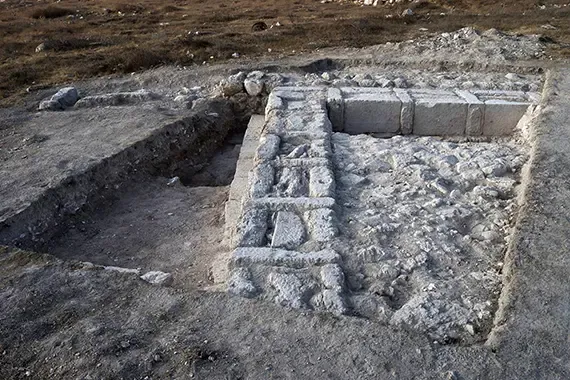
The tomb itself has been dated to the 1st Century B.C. However, attached to the tomb are structures, apparently places of worship, dating from the 4th and 7th centuries. A large well-constructed stone foundation has been uncovered in front of the tomb and it is possible that it might be the Temple of Holy Salome referred to in the inscriptions at the site.
An excavation of the foundation is scheduled to begin in October 2022. Beit Lehi Foundation is a 501(c)(3) non-profit organization based in Sandy, Utah. Contributors interested in participating in the archeological excavation at Beit Lehi should contact the Beit Lehi Foundation directly or through their website www.beitlehi.org/contact.
— END–
Beit Lehi is an ongoing excavation project about 22 miles southwest of Jerusalem. It is situated within a geographical region known as the Judean Shephelah, or Lowland, between the Judean Hills in the east and the coastal plain in the west where so much biblical history took place.
Dr. Oren Gutfeld believes that settlement may have existed at the site as early as 1100 B.C. (Iron Age I) as part of the Kingdom of Judah (see Judges 15:14-19). The site was abandoned during the Babylonian conquest in 586 B.C., and soon after reoccupied by the Idumeans who came from the southeast (King Herod was half-Idumean). Around 112 B.C. the area reverted to Jewish control under the Hasmoneans/Maccabees, remaining so into the Herodian, or Late Second Temple, period.
Following the First Jewish Revolt against Rome (66–70 A.D.), the site seems to have been abandoned. It was resettled about 300 years later, in the Byzantine period, as a Christian village. Although the site remained Christian following the Arab conquest of the land of Israel around 636 A.D., by the late 8th century its Christian inhabitants seem to have been replaced by Muslims.
During the following centuries, Beit Lehi seems to have existed as a small, modest village, finally abandoned in about the 13th or 14th century. Since then, the site lay undisturbed, with centuries of rain and wind doing their best to cover the existing structures. To date, Beit Lehi is the largest lost city ever discovered in Israel.
Beit Lehi Foundation is a 501(c)(3) non-profit organization. Those interested in contributing or participating in excavation efforts should contact the foundation at www.beitlehi.org/contact.
Further Information: Alan Rudd, President
Beit Lehi Foundation, Inc.
arudd@beitlehi.org
Beit Lehi Foundation
75 Towne Ridge Parkway, Suite 125
Sandy UT, 84070
Was Beit Lehi the home of Lehi and Sariah?
In 2009, professor Jeffrey R. Chadwick shared his personal opinion that Beit Lehi could not be the ancestorial home of Lehi and Sariah, two characters from the Book of Mormon. His argument is based on his misinterpretation of the word “at” as used in 1NE 1:4 and 1NE 1:7.
In 2015, Captain Kirk clearly demonstrated in his article titled “At Jerusalem“, that Beit Lehi located 22 miles south east of Jerusalem, could be Judean home of Lehi, Sariah, and their children.
While we currently have no archeological evidence that this was Lehi’s home, it does not remove the possibility that Beit Lehi could have been the ancestral home of Lehi and his family.
Drone survey reveals ancient temple at Israeli military grounds.
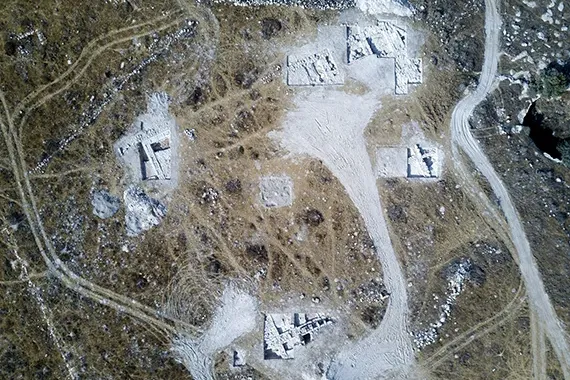
In 2015, students from Utah Valley University were the first to use images from drones to create 3D topographical map of Beit Lehi. This 3D map provided archaeologists an unique overhead view and to locate a possible temple site at the north of Hurvat Amuda for the 2017 dig.
When drones buzzed at the heart of a Lachish region military training area this Sukkot, they came up with an unusual find. The camera-equipped aircraft discovered what appeared to be a rare 2,200-year-old Idumean palace or temple — one of only a handful in the country.
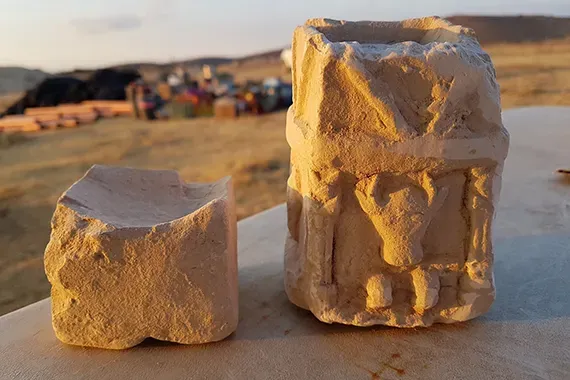
In a survey of an area from Beit Guvrin and Maresha in the north to Moshav Amatzia in the south, the drones’ aerial images indicated the possibility of remains of the Hellenistic period structure, which turned up an altar decorated with an image of a bull in relief.
Rare incense altar found in the excavation at the heart of a military training area in the Lachish region: on one side is a bull in relief and on the other is another animal, possibly a horse (Clara Amit, Israel Antiquities Authority)
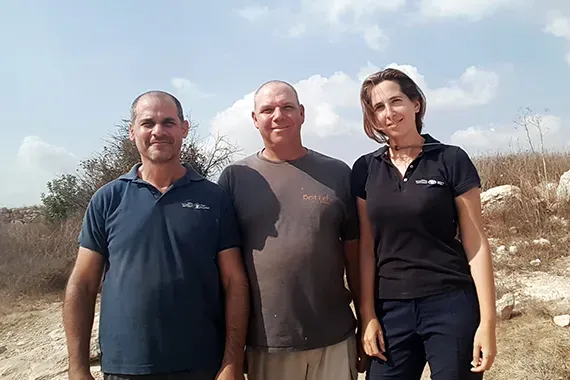
“This technology helped us choose where to focus our excavation probes, and, indeed, it very quickly emerged that this was in fact a unique discovery,” said the Horvat ‘Amuda excavation directors, Dr. Oren Gutfeld of the Hebrew University, and Pablo Betzer and Michal Haber of the Israel Antiquities Authority, in an IAA release.
“If this was indeed an Idumean palace or temple, it is a rare and exciting find – similar structures in this country can be counted on the fingers of one hand,” said the archaeologists.
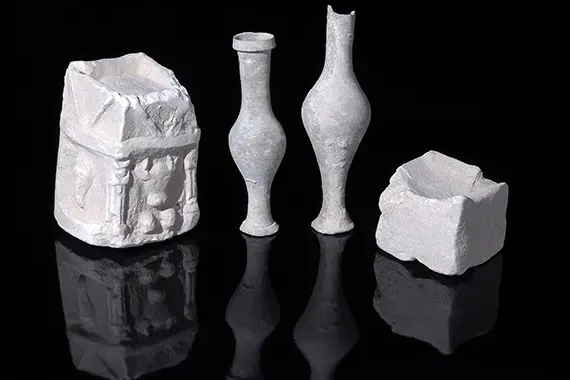
In one of the rooms excavated at the site, two stone incense altars were uncovered. The bull adorning one of the altars “may have symbolized a deity worshipped by the Idumeans,” they said. It is standing upon “what is apparently the facade of a temple adorned with magnificent columns,” according to the IAA.
The altar, noted the archaeologists, is “a unique and rare find in terms of its decoration.” Additional findings include painted bowls, juglets and oil lamps made of delicate pottery.
But it appears the Idumean structure was intentionally dismantled, “perhaps during the Hasmonean conquests of the region,” the IAA release said.
In 112 BCE, the Hasmonean king, John Hyrcanus I, razed Maresha, a nearby Idumean stronghold where some 6,000-10,000 people had lived during the Hellenistic era. “Residents are forced to convert to Judaism or leave,” according to a Biblical Archaeology Review article by a previous area excavator, Amos Kloner.
Later, in 40 BCE, “after Rome conquers the Seleucid empire, the Parthians (allies of the Hasmonean leader Antigonus Mattathias) destroy Maresha as part of a campaign against Herod. During the Second Jewish Revolt against Rome in 132–135 CE, residents of nearby Beit Guvrin cut low narrow passages and square rooms at Maresha to serve as hiding and storage places,” according to Kloner.
The area around Horvat ‘Amuda is rife with remains dating from the Jewish revolts against the Romans, including hiding tunnels and a complete cooking pot from the Bar Kochba Revolt, circa 132-135 CE. Additionally, the archaeologists discovered other underground spaces, perhaps used as ritual baths, oil presses, and dovecotes akin to those of nearby Beit Guvrin, or quarries.
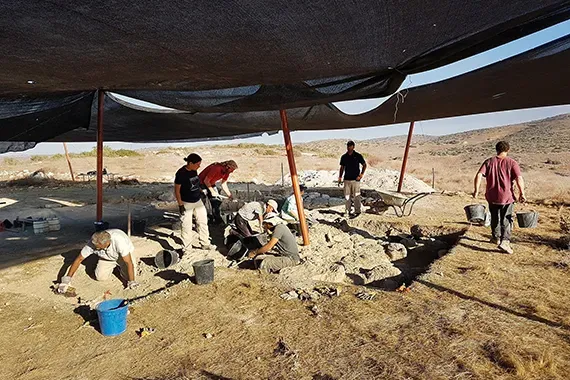
The excavation was sponsored by the IAA, the Beit Lehi Foundation, and Utah Valley University. Archaeology students from the Hebrew University and Bar-Ilan University as well as students from the Architecture and Engineering Design Department and Digital Media Department at Utah Valley University participated.
“We hope that our continued excavation of the site in the spring will uncover more of the story told here,” said the archaeologists.
New Olive Press Complex Discovered
On May 11, 2019 Oren Gutfield, the lead archeologist from Israel, and a team of UVU faculty and students crawled on bended knee through a narrow tunnel and discovered a cavern with three complete olive presses. The tunnel was originally a small hole inside one of the smaller columbarium. Mounds of rock and dirt prevented easy entrance, but Gutfield and his UVU team were determined to dig up another discovery. After a few minutes, with the use of his pickaxe and hoe, Gutfield took a deep breath in, squeezed inside, and disappeared from sight. Soon, his voice came floating through the dusty darkness, he informed the group in Hebrew that he was stuck but gave a great laugh. Then he instructed those that were left behind to continue to enlarge the opening a little more and then to follow him. The room beyond, he declared, was amazing. The team set to work and one by one wormed through the tunnel. With their pants crusted in dirt and rocks floating amongst their hair, the UVU personnel emerged into a complex contained three well-preserved olive presses and the possibility of a fourth, now half buried under hundred years of dirt and disuse. Visible amongst the dirt was the obvious niches in which the people of Beit Lehi would crush their olives to create oil. Excitement was riddled on Gutfield’s face as he spoke in a mere whisper, “It’s perfect. It’s complete.” Quickly, he began to make plans the excavate the area next year. It seemed, however, that he couldn’t wait so long, as he immediately began to pull rock out of holes brush dirt off the olive presses. Then, for just a moment, the team took a moment to stand in awe and admire Beit Lehi’s most recent discovery.
This Olive Press complex is located in the Horvat A’muda area (or Place of the Pillars) which is the northern neighborhood of the Beit Lehi Regional project. This region now covers 36 square kilometers. You can view the panorama and experience this striking discovery for yourself.
-McKayla Boyd , UVU English Department
Roman Era Tomb Photographed
Near the main Beit Lehi campsite at Horvat A’muda is a narrow trail in the tall dried grass going East. At the end of the trail is a large rock with an arched opening about 12 inches tall in the center. UVU students and professors crawled through this narrow passage and found a 5-foot drop to a smaller opening cut into the stone many hundreds of years ago. Going face first down the incline and squeezing through a cobweb covered opening in the stone wall brings you into a small roman era tomb filled almost to the top with dirt. This tomb cut into the soft limestone with hand tools has 10 burial niches. Oren Gutfeld, the lead archeologist, said this was most likely meant to be a burial tomb for a family. Now you can view this tomb before it is excavated.
-J.J. Tenney, UVU Digital Media
The Temple at Beit Lehi
We now have the latest video on the discovery me made last year of the temple at Beit Lehi. There is a small dig going on now but a full dig is being scheduled for April or May, 2019. Let me know if any of you adventurers want to go and continue uncovering the Temple. We will also begin excavating the Iron Age II (588 -1200 BC) structures we discovered this past year. There are groups that have already expressed interest in both excavating at the site and touring.
Monumental from Beit Lehi Foundation on Vimeo.
Spring 2013 Virtual Tour Shoot
In January of 2013, a team of students and faculty from the Digital Media Department led by Alan Rudd, President of the Beit Lehi Foundation make a trip to Israel. Their primary purpose was to photograph 360 degree virtual tours and record videos of Oren for the website. While there they were able to photograph the Tomb of Salome which has since suffered a minor cave-in and in not accessible at the present time.
Fortunately, you can take a virtual tour of the Salome Cave from the comfort and safety of your living room without fighting all the bugs that really enjoyed biting those who came into the tomb.